Thursday, July 4, 2013

Space Colonies Inside Irregular Asteroids

Any asteroids within the size-range suitable for a early gravity balloon colony would likely be highly irregular.  That is to say:
  1. the body exhibits a non-spherical shape, like a blob
  2. its rock has some amount of compressive strength
This was established with my last post, where you can see that basically any body with a natural internal pressure of 0.3 to 10 Earth atmospheres is likely to be irregular.  Those are also the internal pressures you need to use it as a colony.  Now, I'm using the term internal pressure, but so far I'm only referring to the contribution of self-gravity to internal pressure.  It could be more or less according to how the asteroid formed and what kind of internal forces it experiences as a result.  In this post I want to talk about how you would manage the most obvious kinds of internal forces for an early gravity balloon colony.


Irregular Asteroid Stresses

Call the largest dimension the polar axis.  This is chosen because it is the axis of symmetry.  In that case of planets, the axis of symmetry is typically the smallest one because they are roughly oblate spheroids, whereas 10-km scale irregular asteroids are more like a prolate spheroid.  In other words, this is the geometric model I'm using:

My terminology:
large dimension = polar axis
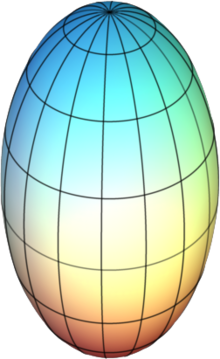

This doesn't look very far off for many of the asteroids we've photographed.  Eros, in particular, among others.  With this in mind, we can consider the stresses that he object's own self-gravity will cause on its interior.  For a mental model, this is somewhat similar to a building on Earth.  In order to "stick up", it has to have some strength.  The only difference between an asteroid sticking out as a prolate spheroid and a building standing up on the surface of Earth, is that the asteroid deviates from a spherical shape, while the building deviates from the flat surface of the ground.

This protrusion will only lead to compressive stress here.  After all, it doesn't have to stand up to the wind or any other dynamic forces.  If you want a rough formula for exactly how much compressive stress, then consider the gravitational head.  For a bad approximation, imagine that the gravitational field only varies with radius.  Then it's obvious that the equatorial radius is smaller than the polar radius.  That leads to an inconsistency if you imagine the object material is fluid-like.  You obtain a different pressure if you measure the elevation drop from the equator surface to the center versus if you measured from the polar surface to the center.  It is precisely the difference between these two pressure that is the non-isotropic force, or the compressive force.  It has the same units as pressure, because these are both elements within the stess tensor - the bread and butter of civil engineering.  After all, the entire proposal basically comes down to civil engineering.

For some math, you can imagine that this stress will be approximately equal to the gravity on the surface of the asteroid (which is an average figure itself) times the elevation difference at the equator and the pole.  Without going into details here, you can get a factor of 2/5 to add onto this.  This isn't perfect, but it's pretty good.

$$\sigma_z \approx \frac{2}{5} \rho g \left( R_x - R_z \right)$$

To illustrate the occurrence of this compressive force, I've used some arrows here.  Imagine that a pressure without any material stress would entail 4 arrows from all directions in this 2D approximation.  In reality pressure acts all around you.  So instead of that, we have some preferential direction where the pressure squeezes from only two sides.  I did my best to illustrate that for the prolate spheroid shape I'm talking about here.  This is briefly representative for the natural state of the asteroids I'm talking about.


You can easily extend the idea to a hole in the center.  About the same amount of net force will be present over a cross section at the equator.  If you drill a hole in the center, that means that there's less area over which to distribute this force.  Logically, that means that the stress would be intensified by the presence of this hole.

There are some finer points to this argument - mainly that in the above model the bubble would have to have some internal pressure.  This is what we're talking about for the gravity balloon.  Specifically, the pressure would have to be exactly enough such that the top and the bottom of the hole in the above image wouldn't experience any compressive stress.  You could change that with a different pressure inside the bubble.  If you increased the pressure in the bubble enough you would induce tensile stress - stress that tears the material apart, not pushes it together.  I have assumed that the pressure set-point would be carefully managed to keep all stresses compressive.

Why would you want to do this?  Because of the failure mechanisms associated with breaking.  If you compressive force doesn't hold up, then you could see some material rearrangement - just like if you had built your sandcastle too high.  That might still not result in loss of atmosphere.  Particularly if you had added some membrane to keep the atmosphere from diffusing into the rock to begin with.  There still remains a danger that whatever material rearrangement happens would destroy some part of that membrane, but it's still a smaller danger compared to failure of tensile stress holding the atmosphere in.  If you relied on the tensile stress of the asteroid, you would risk a catastrophic loss of atmosphere.  This is the same sort of event we concern ourselves with the international space station, or any similar design.  Breaks are generally fatal.

Impact of a Deformed Central Bubble

Similar thought experiments can be used for imagining that a small bubble is deformed in the shape of a prolate spheroid.  Start with the assumption that tensile forces are unacceptable.  Then imagine that we deviate from the spherical shape that I've always talked about for the inner bubble of air.  If you do this, that is effectively adding material around the equator region and subtracting it from the polar regions.

In doing this, we introduce a quadrupole moment.  This behaves as you would expect from a quadrupole field:

generic example of a quadrupole field


But in the case of a gravity balloon, we can only allow compressive stress, by adjusting the pressure of the air bubble lower.  Start out drawing the gravitational field lines from the quadrupole gravitational moment.  Then, due to the compressive stress argument, draw a compressive stress in all places where two arrows point toward each other.  This is what I've done in the image below.  You still have to use your imagination to think of this being an prolate spheroid.


There is an obvious utility to this - because the compressive stresses are in the opposite directions to the stress from the asteroid shape itself.  That means that an odd shaped bubble may be used to less the compressive forces within the interior of the asteroid.  That is exactly what you would do for management of interior forces, building a primitive gravity balloon colony.

In short, the combination of the two above stress diagrams gives a result that is overwhelmingly balanced back to isotropic forces.  That is, just pressure, no material stresses.  Like illustrated below.


gravitational balloon designed to relieve
stress within the asteroid rock

There's no reason to believe this could be done perfectly, but I haven't done the calculations.  I imagine it would be quite an involved project to do so.  Even as we imagine there will be some residual forces, it needs to be considered what the criteria is.  There seems to be every reason to believe that you could start with an asteroid like Eros and establish a colony with breathable air, several kilometers in diameter, all the while keeping the asteroid internal forces less than its natural state.

You would not want to stress the asteroid more than its natural state, because that will give you a virtual guarantee that loss of atmosphere will not happen.  That's the type of guarantee needed to have people seriously consider moving there, and that's why a gravity balloon is a competitive concept for space colonies.

Irregularity of Asteroids by Mass

The very fact that an asteroid is non-spherical proves conclusively that it has some material strength.  It would then be tempting to use its material to hold in an atmosphere, literally with no processing at all.  This would be cheap, but it would also be potentially dangerous as well as unnecessary.  The reason lies in a mass-scale argument.

Looking at what we know about asteroids, we can find that the size cutoff at which most bodies appear highly spherical is fairly close to the point where their internal pressure approaches 1 Earth atmosphere.  Because of this, it would be tempting to imagine that an asteroid's material strength may be nearly sufficient to maintain an atmosphere.  There are a few hazards with that argument, but the main takeaway is that it's not necessary.  Basically, self-gravitation is more useful than tensile strength because we have no reason to believe that an asteroid's natural tensile strength is reliable.  There are more complicated arguments involving the role of compressive strength, but I'll get into those with a later post.

Abundance of Irregular Asteroids by Pictures

Here are a few examples of asteroids at different scales that we have pictures of.  There is a combined imgage out there which preserves the length scale, although this isn't as useful as just looking at the images side-by-side, since I'm interested in their degree of irregularity.


PictureNameM (kg)Center Pressure
due to self-gravity
(in Earth atmospheres)
Type

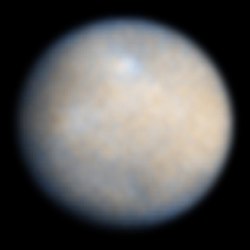
1 Ceres9.4 x 1020221spherical

4 Vesta2.6 x 1020185borderline


21 Lutetia1.7 x 10186.3irregular

253 Mathilde1 x 10170.27somewhat
spherical

243 Ida4.0 x 10160.36irregular

951 Gaspra2.0 x 10160.24irregular


433 Eros7.0 x 10150.12irregular


2867 Steins1.0 x 10140.0032irregular


4179 Toutatis5.0 x 10130.0027somewhat
spherical


25143 Itokawa3.0 x 10102.0 x 10-5irregular

There is somewhat a deficit of information beyond this.  If you want to see more pictures of asteroids (like I do), you might be out of luck, because almost every one of the pictures above represents a major space exploration mission.  There's also a pronounced deficit of information for Earth-like center pressures, since the above tables skips over an order of magnitude between Mathilde and Lutetia.

Note that pressure doesn't follow directly from mass.  This is because the objects have different densities, and I used those when calculating the center pressure.  A lower density will result in a lower central pressure, even for the same total mass.  That is simply a quirk of self-gravitation.

Once we get to the extremely small bodies, they seem to commonly take on the shape of an prolate spheroid.  Beyond one Earth atmosphere, the bodies all seem to conform to a roughly spherical envelope, even though there are a lot of irregularities on the surface.

For those small bodies, it's interesting to note that the speed of rotation also puts a limit on the amount of material stress we could expect from them.  A list of fastest rotating objects shows that some have a rotation on the order of a minute, but these are all several meters in diameter.

Largest Bodies Identified Irregular

Another reference for this is the Wikipedia list of solar system objects by size.  I went through that table and grabbed the largest objects that were identified as irregular.  This is a good approach because it gives a mass figure below which irregular objects start to appear is large number.  However, its major shortcoming is that we have no idea how many corresponding regular bodies exist around their mass scale.

ObjectM (kg)Shape
Proteus (moon)5.0 x 10¹⁹ irregular
Nereid (moon)3.1 x 10¹⁹ irregular
52 Europa1.7 x 1019 irregular
Davida4.4 x 1019 irregular
Sylvia1.5 x 1019 irregular
Cybele1.8 x 1019 irregular


Reasonable accounting would put the limit for irregularity at somewhere between 1017 and 1019 kg.  However, the limit I've found for a habitable inner pressure is around 1016, and can even be lower than that.  Engineering limits are still more complicated.  Even though bodies in this size range are irregular, they're still roughly spherical in many cases, indicating that material strength doesn't hold up on the scale of self-gravitational forces.  Within the size range we're interested in, the bodies are showing that they withstand some deformation against the equipotential criteria, but exactly how much is unclear.

This evidence does give a clear message - that using an asteroid to hold breathable air would involve both self-gravitation forces, as well as some material pushback.

Thursday, May 9, 2013

Centrifugal Field Divergence for a Rotating Planet

Centrifugal Potential is a false potential within the context of a rotating reference frame, which can be thought of as coming from the false Centrifugal Acceleration.  I was reworking through some of the details of this and was going to post a question to Physics Stack Exchange, but it turned out that my knowledge was complete enough to not really merit a question, because I had nothing to ask, so I'll post the work here.

This has application to a rotating planet.  The mathematics for Centrifugal Potential is general to any rotating field.  I'll call it ur.  Call the angular speed omega, and distance from the axis of rotation rho. The potential can be arrived at several ways, and they all give the following.


I would like to find the Laplacian of this.  This would be the same thing as the divergence of the Centrifugal Acceleration.  With the potential in the above form, if I understand correctly, we have to use the cylindrical version of the Laplacian.  The cords (rho,phi,z) are (distance from axis, azimuth angle, and vertical position).


The last 2 derivatives are zero, and we can expand the first.


I questioned the factor of two, but now I think that's probably correct.  This would be useful to compare this to the divergence of Newtonian gravity which can be found from Gauss' law, which I'll call ug.


If we use Gauss' law again, then would we be able to make a 100% true statement about the integral of gravity over the surface of a rotating planet?  We would need to take dot product of gravity with the surface, but if it fits the hydrostatic condition then all gravity is normal anyway.


The two volumetric terms only depend on density.


Is it then permissible to write the following?


With this, we have two extremely interesting terms.  I think the most interesting thing is the ratio of them.  For instance, with Saturn, I calculate the rotational term is about 10% that of the gravitational term.  This means that the rotation subtracts 10% of the surface gravitational flux that its gravity creates.

It's hard to extend that statement very much further.  We would be tempted to say that someone standing on the surface of Saturn (ignoring the actual complications in doing this) would weigh 10% less due to the planet's rotation, but that's not completely correct because gravity isn't the same everywhere to begin with.

This does have some application to gravity balloons.  We can apply the concept of Gauss' Law balance to different volumes.  For instance, if we assume that the inner pressurized volume has effectively zero mass, then that implies that a rotating gravitational balloon would have a net outward field on the walls.  That means that over time things would avoid the center and move toward the walls.  That's an interesting effect and it would have a positive impact on stability, causing the Raleigh-Taylor effect to no longer want to mix the walls up.

If you wanted to take this to the absolute extreme case, you could imagine creating artificial gravity on the inside walls by rotating the structure fast enough, while still holding it together through self-gravitation.  In principle, this could possibly work, but to make Earth-like gravity, the mass required would be much greater than Earth itself.

Friday, May 3, 2013

Clover Orbits and Heat Removal


Without engineered solutions, any gravity balloon is thermally isolated.  The 10 km of rock would prevent any significant heat loss by conduction, and there is no other mechanism to get the heat out.  An engineered solution would have to entail some kind of matter exchange.  For small conceptions of the idea, this could probably be done in batch processes, which would also make more sense in the context of access tunnels and the airlock structure.  Once it gets much larger, however, there's a bit of a different challenge.  As the size grows, the habitable volume grows with the cube of the linear dimension.  In light of that, I want to talk about solutions for cooling that scale very well with large gravity balloons.

Pipelines in Zero Gravity

The idea of machines (and industrial society in general) spanning large swaths of volume in zero gravity is an exotic idea.  You can reliably have a process that involves huge exchanges of mass and even huge velocities while at the same time putting very little energy into it, and actually having very little rigidity to it.  The engineered systems in this environment could be large, complex, but fragile.  Imagine a normal train and the sheer impossibility of stopping such a thing, and multiply that concept by a thousand.  People won't even be worried about such huge huge things moving about because it would be so easy to move around it.  This is a true embodiment of the relative-ness of motion.  For a simple example, image a large pipeline of things moving in a giant circle.  This pipeline could be a simple ring, but with a thickness much smaller than its radius.

Moving from the inner surface to the outside surface requires doing work because there is a gravitational field.  If you're moving individual objects it also requires the energy to move in and out of the airlock, but we can imagine a smooth pipe that doesn't have this burden.  You don't necessarily have to put in the work against the field every time.  If the stuff you're moving is already moving sufficiently fast then it can make it out without much problem.  In a simplistic sense, we can imagine a set of tunnels in the rock, some going out and some going in.  After the cooling mass goes out a hole, then it makes its way to the "in" hole moving along the simple geodesic.  In this case, by geodesic, I mean a path traveled in free-fall.

Pragmatically, making a large pipeline of material going through an access tunnel would be quite an engineering feet, but mostly due to the challenge of keeping the air in.  In fact, the challenging of maintaining a pressure boundary over a moving surface is quite common in engineering and there is certainly no simple solution.  However, in the case of the shell of a gravity balloon, there would be abundant space over which to implement this solution.  Ultimately, this could provide an easier way for even people to get from the inside to the outside than by constantly messing with batch-process airlocks.  Another complication is that the shape would have to deform as the speed changes due to gravity.

Orbits Moving In and Out

Interested in how you would actually have to configure these holes, I asked about the problem in a limit case on Physics Stack Exchange.  To make the answer simple enough, we imagine that the rock is thin relative to the overall dimensions of the thing.  That now fits the same problem of a charged particle orbiting in and out of a spherical wire mesh at some voltage.  There was a very intriguing answer to that question.  Basically, there are huge number of ways to configure these odd orbits.  Not only can you have any given number of "dips" outside the shell, but for a given periodic number, you can have any degree of roundness you like.

The most practical case for industry in a gravitational balloon is obvious to me as the 2-exit orbit.  I've dubbed this a "2-gon" in the question on Stack Exchange because it exists within a family of chopped polygons.  This would be an ideal orbit for a pipeline into and out of a gravity balloon because it hits the walls at a high angle, limiting the distance of tunnels needed, and it can have a long path length within the center.  You can see in the question that for a larger number of dips it skirts the edge more, as opposed to making deep secant lines.

The 2-gon orbit
image by Physics SE user JJ Fleck


For gravity balloons of more moderate sizes, a large fraction of the orbit would be spent within the rock itself.  I tried to give some thought to the orbital shape within that rock.  I asked a question about a similar case of something orbiting within a field that was proportional in strength to the radius.  However, I realized that this doesn't fit the shell volume that I'm speaking of here.  The field is linear with radius but it is not directly proportional to radius.  That makes the solution for the orbit rather complicated.  Ultimately, it's sure to be a relatively small revision on what kind of shapes you can expect, but it needed to be mentioned.

The question remains of how practical this would be.  Particularly, how fast would such a cooling pipeline move?  We could use orbital dynamics, but there's another way to cheat and get an answer simply.  In the large case we know exactly what the gravitational field on the surface will be, provided we have the required internal pressure.  In this case the rock density doesn't even matter due to interesting mathematical conclusions.  The field is just:

$$g = 2 \sqrt{ \left( 2 \pi G P \right) } = 0.013 \frac{m}{s^2}$$

With this, I can generally answer the question of the orbit time for a coolant loop.  Again, for the large limit, there is a helpful simplification.  Just imagine the field on the surface to be constant.  Then we can get a time for the turn-around as well as a velocity.  The velocity should probably be kept well below the sonic velocity of the atmosphere, and ideally we would like to see round trip time less than a day or so.  To make this workable I assumed a generic velocity of 50 miles per hour, or 22.3 meters per second.  With that, the height a pipeline will protruce above the surface before naturally falling back down is calculated.

$$1/2 a t^2 = h \\ v = a t = sqrt( 2 h a ) $$

Numerically, plugging in the 50 mph figure:

$$ h = 1/2 v^2 / a \approx 20 km \\ h \approx \frac{1}{2} \frac{\left( 22.3 \frac{m}{s} \right)^2 }{ 0.013 \frac{m}{s^2} } \approx  20 km $$
This is a nice answer because it is on the order of the shell thickness in the first place.  That means that even if the case we're looking at isn't all that big, if the center bubble is just a few times greater than the shell thickness, the idea will be perfectly workable.  Now, with this speed we can imagine the travel times for certain things.  Even for a giant diameter of 250 km, it would still only take 3.1 hours to traverse the diameter at the speed.  You can then imagine multiplying this by 2 for the reverse trip.  Then, for the times spent outside the shell we'd be looking at about half the average velocity.  So credit about 10 km shell thickness, 20 km turn around distance, then a full orbit takes about 30 km of that distance.  This adds about .3 hours.  So for a full pipeline orbit through a 250 km gravity balloon, we'd be looking at a time on the order of about 7 hours.

There are several variables I haven't delved into, like the overall cross sectional size of such a space pipeline, but even with a normal "train" size, such a thing could be used to transport massive amounts of heat.  There are a lot of remaining complications, but it would scale very well.

Wednesday, April 24, 2013

How Many Asteroids Would it take to House all of Humanity?

Arguing that humans should live inside asteroids naturally leads to the question of quantity - would there be enough resources in asteroids to be home to the entire population of humans?  What are the limits exactly?  The question is mostly unanswerable when the reference concept is rotating space stations, as this depends on the state of technology.  In this blog, I'm limited to a specific mechanism, which is containing air with the self-gravitation of an asteroid.  Therefore, statements about quantity can be conclusively made.  Of course, there is still ambiguity, which I will get into.

To begin with, I must return to the basic state equation that governs a gravity balloon.

$$ P = \frac{2}{3} \pi \rho^2 G t^2 \frac{\left(3R^2 + 3 R t + t^2\right)}{(R+t)^2} $$

This relates 3 variables, pressure, density, and radius.  You need to draw the parallel between volume and the inner radius.  Plus, there's somewhat of a 4th variable, which is the total mass of the structure, which can be substituted in and out (numerically usually) with the shell thickness, t.  In the process of inflating an asteroid to make a habit the rock mass is constant.  Really, you could say this equation is dual to the ideal gas law, in that combining the two fully determines the inner radius (and all other parameters).

Now, given that we have this relationship and methods for solving it, the number of humans that an asteroid or collection of asteroids can house depends on two factors:

  • how much space you require per person
  • how low of a pressure is okay
I've dealt with the latter issue in previous posts.  Since using in-situ resources would be an absolute requirement, it would make sense to use as much atmospheric pressure as sea-level on Earth or less, where the lower limit is dictated by biological tolerability of low Nitrogen content.  Because of that, on this topic of availability throughout the entire solar system, I'll reference those values of sea-level pressure and 34% of sea-level pressure.

For the other limit, the amount of space to comfortably house a human, the numbers are much more ambiguous.  On the one hand, we can compare this to other space stations, so I looked up the crew and volume of the International Space Station (ISS), getting a volume per person in cubic meters.  We would want more volume than this, but it is an instructive lower bound.  For the upper bound, we can look to Earth itself.  How much atmosphere do we have per person?  That's not a straight-forward question because we all live at different pressures, but with a reductionist goal, I simply divide the mass of Earth's atmosphere by the sea-level density.  That gives the volume you would expect if you made a giant balloon of with all Earth's atmosphere and compressed it to sea-level pressure.  Obviously this is an overshoot, but that's good, because we now have a clear overshoot and undershoot.  These are different by roughly a factor of a million, so I introduced a middle-range number that's the square root of those two numbers multiplied.  It's fairly arbitrary, but as far as I can guess, it's probably the best shot at a comfortable volume requirement for people.  A 62 meter cube is awfully big, but we should consider that plants and other life would be important as well.

Reference Cases for Volume Requirement
ISSGeometric MeanEarth
V (km3) per person0.00000010.0002378470.565714286
V (km3) for all humans7001.7E+064.0E+09
Side length (m)4.662.0827.1
(side length is the side of a cube if the volume 
was divided up to a cube for each person)

Unfortunately, I don't expect that I'll do better than a factor of a million.  I can get all kinds of (also subjective) numbers for population density per area, but there's no clear idea of the ideal population density of humans per unit volume.  In order to appreciate the full weight of the problem, it's useful to consider both extremes.

The one piece of information still missing is a list of existing asteroids.  This would be complicated (though not impossible) to do one-by-one, so I'm using a size distribution function instead.  The data to do this is very widely published, and I opted to simply use the size distribution list from Wikipedia.  The table there gives a cumulative distribution.  That is, the number of asteroids above so-and-so diameter.  Effectively, a cumulative distribution function (CDF).  I obtained a simple power distribution for the data.

Asteroid Size CDF

Now that we have the CDF, we can also obtain the PDF.  Of course, it is the derivative of the former, but since the CDF counts from largest (starting with Ceres) to the Nth asteroid, it's the PDF is the negative of the derivative.  This is simply an artifact of how the counting is done.

Distributions in km

$$ \text{CDF} = N(>D) = \left( 1.77 \times 10^6 \right) D^{-2.12} \\ \text{PDF} = \frac{dN}{dD} = \left( 3.76 \times 10^6 \right) D^{-3.12} $$

The data was limited to sizes that I already know would be usable as gravity balloons to get the best possible numbers.  The exponent is somewhat consistent with other studies on the subject, which found an exponent of -4 (for the PDF) for the large asteroids.  I will still use my above number since I know for a fact that it reproduces the numbers I want in this narrow range.  With this, all of the information is there to find how many asteroids it would take to house all the human population given some pressure and volume requirement.

The form of the proposal is then to start with the smallest asteroids that is large enough to contain the desired internal pressure, "inflate" that asteroid to a very small volume, then move onto the next one.  This next one is larger and thus, we will be able to inflate to a larger inner volume.  This continues up the size scale of asteroids until the sum of the internal volumes of all the inflated asteroids comes out to the volume requirement.  Density is required for these calculations.  In previous posts I assumed a density of 1300 kg/m3, but here I'm changing that to 2000 kg/m3.  Reason being that larger asteroids tend to have more volume, and the 1300 number was only a conservatively low number for fairly small asteroids.

On the subject of density, we frankly have no good idea of how dense these asteroids are on the whole.  Generally speaking, the measurements of size come from back-calculations from the amount of light we get from the objects.  This light does fairly faithfully represent the surface it exposes to space, and that says nothing at all about density.  Because of this, we know diameters with much better certainty than what we know mass.  For much larger bodies, there is another method for calculating mass, which is to observe their gravitational interactions.  This method is completely impractical for the 5,000-some asteroids contained in the set that I'm interested in.  It probably wouldn't be possible to employ the method even if the resources were there to do it on one, and doing it for a large number of the asteroids is even more impossible  Given that, asteroid density will remain a very major source of uncertainty in all this writing.  There isn't a clear basis to employ the figure of 2000 kg/m3 for the density of the set, but the densities are sporadic in the first place.  I would prefer to just avoid multivariate PDF integration for the time being.  There is certainly room for someone to write an academic paper about reasonable expectations for the full size and density distribution among asteroids.  I've found myself at the practical limit of this research so that's my justification for using this generally representative number.  It's possible to test the method with different densities and it changes within possibly an order of magnitude with a reasonable density range.

Cumulative Volume from Inflating Asteroids


A fun way to give the answer to this query is to say "to get a pressure of 1 atmosphere you need to use asteroids A to Z", meaning that you would need to use all asteroids with sizes between those two candidates.  Because of that, I'm quoting a reference asteroid to get the central pressure with no inflated volume (that is the "A"), and then an example asteroid for every volume case (that is the "Z").  Here are the numbers for the two different pressures.

Asteroids Necessary to Obtain the Volumes at 1 Atmosphere
CaseCumulative
Volume
Goal
D (km)M (kg)Inflated
D (km)
Number
Used
Nth
Asteroid
Uninflated
Pressure
(atm)
starting size026.92.04E+160.0- 277 Elvira1.00
ISS70028.32.37E+162.6162 625 Xenia1.10
Geometric Mean1.66E+0642.88.21E+1626.4997 132 Aethra2.53
Earth3.96E+09241.41.47E+19537.41,639 65 Cybele80.38


Asteroids Necessary to Obtain the Volumes at 0.34 Atmospheres
CaseCumulative
Volume Goal
D (km)M (kg)Inflated
D (km)
Number
Used
Nth
Asteroid
Uninflated
Pressure
(atm)
starting size015.74.05E+150.0- 518 Halawe0.34
ISS70016.54.74E+151.6508 433 Eros0.38
Geometric Mean1.66E+0626.71.99E+1618.23,329 274 Philagoria0.98
Earth3.96E+09169.85.13E+18417.65,152 54 Alexandra39.79


For example, in order to get an atmosphere volume equal to that of Earth at sea-level pressure, you would need to inflate all the asteroids larger than Elvira and smaller than Cybele (and possibly include those two as well).  The value of this observation is that it shows that there is plenty of availability of asteroid material with which to make gravity balloon habitats.  In fact, it's not hard to see at all how this approach could easily house more people than all the terrestrial environments in the solar system combined.  I mean, provided that the middle-range value is a sufficient volumetric population density, then we have the potential for over 1000 times that volume, and that's not even touching the largest class of asteroids.

But how constructable would these things be?  As I will write about later, there are some valid concerns of stability although they should be manageable.  It follows that you work harder against the force of gravitational differentiation when you've "overextended" yourself by making an inner radius a great deal larger than the shell thickness.  By looking at the inflated diameter number, you see that that only needs to be true if you require a volume on the scale of what Earth has, which would be a mega-scale engineering problem by its very definition.  If you're looking at the middle-range volume requirement, the inner bubble is still relatively small compared with the overall dimension.

Regarding construct-ability, there's also the matter of the pressure before any inflation takes place.  This could be a problem by making the center uninhabitable while the atmosphere is produced and supporting infrastructure is built.  What is the maximum habitable pressure?  I searched around for a few numbers.  The compressed air reference points are fairly useless, because the atmosphere would be alien anyway.  So given that, the maximum safe SCUBA pressure might be pretty good guidance.  Comparing to the above table, it's clear that in order to make Earth volume scales, you will have to learn to deal with impractically high pressure, so it might be an uninhabitable environment to start out with.  Thankfully, the pressure declines fairly quickly once the inflation is started, which I wrote about in a previous post.
  • trimix suggested                 3-4 atm
  • compressed air limit           6.4 atm
  • recommended diving limit   9.7 atm
  • scuba record                     31 atm
The number of bodies in the above calculation is also of interest.  To some extent, requiring a huge number of space habitats to house your population defeats my previous arguments about the value of a large zero-gravity habitat, which is very easy movement between places.  If the interesting places you want to travel to are all in other habitats, you still are forced to traverse the less-ideal environment of space.  Plus, objects in the asteroid belt tend to have a year-length of 4 Earth years or more.  If we're following the natural flow of gravitational slingshots and such, it would take extremely long times to get to the other asteroids since they're distributed almost completely 360 degrees around the sun (although there is some distortion from Ceres).  Thus, the citification argument would dictate a minimization of the number of habitats which is the opposite of the calculation I've done - which is to use the smallest workable asteroids.  Obviously doing it that way wouldn't be attractive.  It's more realistic that someone knows how much total migration they want to see, then create only a single or a handful of gravity balloons that can handle that amount.  There is almost perfect flexibility to make those decisions.  Consider that the asteroid Cybele, by itself, would have enough volume (when inflated) to satisfy the middle-range requirement.  So you could build that gravity balloon and have 7 billion people move in there.  Those are just the kinds of numbers we're working with here.

Ceres is the largest thing in the asteroid belt, and you can see that the distribution function expects just about 1 object at the large diameter values of about 900 km.  The fact that my math predicts a diameter of only about 530 km is necessary for creation of Earth atmosphere volume shows that the idea is viable, because that doesn't exhaust all of the available mass.  In fact, since Ceres comprises the majority of matter in the asteroid belt, my numbers leave the vast majority of the mass on the table.  Ceres would be pretty impossible to break apart, for what it's worth.  I calculate its internal pressure to be on the order of 900 atmospheres, which is a higher pressure than our power plant turbines use.  This is a very high pressure.

Given some asteroid mass, then provided that it's large, the amount of volume you can obtain by making it into a gravity balloon scales as a 2/3rds power of the diameter.  That exponent comes from the fact that a gravity balloon's functional mass-efficiency is a result of the surface area (2) to volume (3) ratio.  One consequence of this is that you could actually produce a larger volume from the smaller asteroids by first smashing them into each other and then inflating the resultant body.  Ideally, of course, you would just start with a larger asteroid.

What about the moons of the solar system?  I've left those out of consideration so far.  But to get an ideas of the general abundance of things suitable for a gravity balloon, I looked at what internal pressures you can find in the moons of various planets.

Number of Moons of Planets with
Internal Pressures in Given Ranges
0.34 - 0.8 atm0.8-30 atmhigher
Earth001
Mars100
Jupiter1075
Saturn226
Uranus1425
Neptune193
Total282020

(Pluto not included because it's not a planet)

There are two major observations here.  One, the asteroid belt has a vastly superior population small bodies (it also helps that it's closer to Earth than most planets) that would be good for small gravity balloons.  If you wanted Ceres-sized things, however, there are a huge number of moons with absurdly huge internal pressures.  It would be extremely difficult to do this in practice, but it's obvious that the matter of moons is easier to get to than that of planets themselves.  The volume you could create with these objects goes through the roof.

If you inflated the moon in the simple way that I've written about so far, then you would end up with an object several times larger than the Earth itself (not the atmosphere, the whole thing).

Saturday, April 20, 2013

The Curious World of Artificial Gravity

Writing about space stations with artificial gravity, its fairly common to see people restrict themselves to a diameter of 500 meters or larger.  This follows mathematically from a commonly cited figure that Coriolis forces can be hard to tolerate at more than 2 rotations per minute.  If you require the production of 1 Earth gravity, then the required size is about 225 meter radius, and 450 meter diameter.  That is probably fairly reasonable.  It would be cheaper in terms of material to make stations even smaller, but there are a few reasons that very small habitats could be awkward, to say the least.  Let's look at the basic parameters of this size:
  • Radius set to exactly 250 meters
  • Edge velocity would be about 50 m/s, or 110 mph
  • The change in pressure from the center to the surface is about 1.6% of an Earth atmosphere

For the pressure change from the center to surface, it has to be assumed that the air rotates along with the cylinder.  This is yet another good reason to illustrate these tubes in the way I have in the introduction, that is, a tapered end so that the edge itself isn't directly exposed to the atmosphere.  If the ends are open the the air partially doesn't rotate with the tube, and my view is that these are hurricane-like conditions.  The hydrostatic head from a few 100 meters is a lot, which is effectively what would drive currents.

The really interesting metric is the edge velocity.  Imagine that you hop in a train that is moving in the direction opposite of rotation in this world.  If the train accelerates to 110 mph, it will become weightless.  It still has to work against the drag force from the air (air rotates with the tube).  This phenomenon would exist for any moving thing to some extent.  Your "weight" decreases the faster you move in the direction opposite of rotation, because after all, you're closer to being stationary than the rest of the tube.

Car or Plane Example

It's hard to imagine exactly exactly how this would play out, but that's what we have physics for!  For an electric car, the friction forces include aerodynamic drag, drag on the tires, and some internal losses.  The drag force is fairly predictable as proportional to the density of air times the velocity squared.  The force friction force from the tires, however, is roughly constant.  This isn't a huge surprise when you consider that the concept of coefficient of friction supposes a constant force irrelevant of speed.  But that concept also supposes the force is proportional to the normal force ("weight" in other words) - and this is where things can get interesting.  Let's look at the case of a car driving in the opposite direction of rotation.  In this situation, we can formalize a few things:
  • Weight of the car is equal to its acceleration, which is the speed of the rotating tube, minus its speed, squared times the radius.  R (V-v)^2
  • The drag from the wheels is proportional to the weight
  • The aerodynamic force is proportional to the square of velocity

I listed the constants for a typical car modeled with this perspective.  You can look at things in terms of force or power, but I prefer power because it reflect directly the amount of throttle you have to put into a car to keep it going at some given speed.

We also need to distinguish between a plane and a car, as well as address the issues with traction.  Driving a car is pushing it forward with the force of wheels on the ground.  This would stop working entirely as one approached 110 mph, the speed of the tube, because they would be near zero-gravity.  Tires only world with gravity.  The wheels losing grip and spinning isn't the only problem, you would also lose the ability to steer without slipping (and maybe tipping).  The opposite thing would happen as a car moving in the direction of rotation, the functional weight would increase, the grip of the wheels on the ground would increase, the weight the people feel in the car would increase, and you could steer tighter.  These cases are interesting to me, so I plotted them together here.

Power dissipation when moving against the direction of spin, versus with it
red - moving in direction of spin
blue - moving against direction of spin


A plane is different because it takes off while exerting force on the air.  The forward thrust is thus not dependent on the traction from the wheels.  Of course this is necessary because the plane plans to leave the ground.  You can notice in the above graph that the power required to drive is always increasing with increasing speed.  That's fairly "normal", and it's also what we would expect for a typical car driving in a 500 meter tube.  But to imagine a very curious case, I took the above car model and reduced the air friction by a factor of 10.  The effect this has is to make the tire friction dominate through more of the speed range.  But the tire friction decreases with increasing speed moving against the direction of ground motion.

Power dissipation when moving against the direction of spin
using tire friction + air friction, more tire friction than last graph


If you imagine that this model fits a plane, you discover that something truly strange happens.  At a certain speed you obtain a local maximum in power.  If you were accelerating, slowly increasing the throttle up to that point, then once you reached the point you would experience increasing speed with no increase in throttle.  By the time the system equalized, you would nearly be flying.  This brings up another good point, in an artificial gravity tube you can have wingless flight.  In fact, most flying things we're familiar with can hit 110 mph.  Basically, in this world, planes wouldn't have wings.  It's disputable whether it would have any "cars" in the first place.

Cross-Habitat Structures

You need to consider that for any artificial gravity environment, it will likely make sense to have structures that span the diameter of it.  There are a few reasons why, and the structural motivation is compelling.  Imagine that the artificial gravity tube was built with a uniform strength, designed for a given mass-thickness of load.  If you wanted to expand operations in a location further, it could be difficult.  In fact, putting any large amount of matter in a singular place would cause strange kinds of sagging in the structure.  The mass distribution really has to be uniform along the circumference, but structures that span the diameter could be the exception to that.  By building a tall building on both sides, they could be each others counterweight.  Considering that these would be held by tensile (and not compressive) strength, they could actually be cheaper to build than their equivalent building on Earth.

There is an obvious limitation to this, which is that the gravity decreases as you go higher.  If you are co-moving with the structure, then gravity changes linearly with radius.  So if you move up half the radius to the center of the tube, the gravity will decrease by half.  A 500 meter diameter tube, thus, could host a building 500 meters "tall" but the floors would have gravity evenly distributed along the spectrum of zero gravity to full gravity.  On Earth, we have a handful of occupied buildings that rise over 500 meters at the top, but the rest of mankind's buildings are shorter than that.  Examples:
  • Burj Khalifa                       829.8 m
  • Mecca hotel                      601 m
  • One World Trade Center   541 m
  • Petronas Twin Towers       458 m

If you imagine that gravity as low as 0.9g is tolerable, then you can only have 50 meters of usable floors in a cross-habitat structure, and only 25 meters on each end.  Most typical city centers with a decent skyline have a few buildings higher than 100 meters.  So in short, if an artificial gravity tube was to have the economic density of something like Manhattan, it's likely necessary to have a diameter larger than 500 meters, just to fit the buildings in.

Others have written about staircases that transition to zero gravity.  This idea actually occurs in several sci-fi ideas as well as serious discussions about space habitats.  As for a 500 meter diameter habitat, climbing ropes typically have lengths 30 to 80 meters.  While 500 meters is a lot, it's not unthinkable.  It's also fun to imagine how you could string such things ad-hock.  Anchor one end, then walk around the circumference holding the rest of the rope.  With those tied in sufficiently, you could climb straight across the habitat right away.

Spooky Vertical Motion from False Fields

A good read on the funny behavior of things in artificial gravity can be found here.  One of the strangest thing about living in an artificial gravity environment would be that when you drop something, it deflects some amount.  This reference illustrated this for two cases with 1g of gravity.  The dots show the location every 1/10th of a second.  It illustrates something falling from head-level, and the movement of a body's center of mass when jumping up straight.

Movement of drop from head-level and feet movement with jump
both are for 1g of gravity, taken from spacefuture.com


There are a number of ways that you could go about establishing the physics of such a place.  Logically, you might just want to look at some object, falling or moving, and then consider how the ground would move relative to it.  Another way is a full transformation of reference frames, which is a daunting task in many ways.  The ground both rotates and accelerates.  This nature is shared with orbiting reference frames that are tidally locked.  I tried my best at the problem on Physics SE.  It was surprising how difficult it is to do the full transformation of reference frames.  I want to keep this simple, so I solved a simplified case, to exclusively answer the question of how much an object dropped from head-level would deflect.

Diagram and calculations for deflection of dropped object


Walking through the math, you can observe that the dropped object follows the tangent line from the point where it was dropped.  Until it hits the floor it maintains its original velocity.  The distances that the object and the ground (the point that starts out directly below the object) travel before the hit are illustrated in red.  You can qualitatively observe that the dropped object travels the same total distance that it would have otherwise had it been held at its original elevation.  That allows the establishment of the needed relationships with simple trigonometry relationships.  These are more-or-less summarized in that image.  Then using these, as well as some other substitutions from the fact that the tube has a known gravity, I put the expression in two different forms.

Expression for the deflection distance for an object dropped at delta above the ground
Second expression is the deflection in terms of a fraction of the original height


Plugging in the numbers, this comes out to be quite significant.  If you use a drop height of 1.5 meters (about the shoulders of a human), here are the deflection values for a tube rotating at various rpm values, in order to get correspondence with my reference case and the above 1 and 4 rpm examples.

Given: one Earth gravity, 1.5 meter release height
  • 4 rpm, 50 m radius, 25 cm deflection or 16%
  • 2 rpm, 225 m radius, 11 cm deflection or 7.6%
  • 1 rpm, 900 m radius, 6 cm deflection or 3.8 %
An important observation here is diminishing marginal returns.  The size you have to build the structure goes up very fast just to slow the angular speed down a little.  Plus, the material requirements grow proportionally to radius.  That means that for increasing the material requirements by about a factor of 4 you only halve the deflection effect.  Clearly this would be difficult to do away with entirely.  I think it suffices to say that people living there would always perceive the direction of motion.

The two examples discussed here of a car and a falling object are useful mathematically.  The reason being that this part of the fictitious forces comes from a cross-product of the object's velocity with the tube's angular momentum.  The angular momentum goes in the direction of the tube's axis.  That implies that you don't experience this type of force when moving in the direction of the tube's axis, and this is correct.  If you were to throw a ball, there is "distortion" in its path if thrown up or in a tangential direction, but not really when moving down the length of the tube.

Maybe this isn't all that bad of a thing.  I am reminded of a particular experiment which attached a special belt to study participants.  The belt was lined with vibrators.  Only the vibrator on the north side would vibrate, but it would do this all of the time.  It was found that the participants adjusted to life with the belt to an extent that was downright creepy.  Their brain had found a way to use the new sensation to help orient themselves and navigate as a classic example of sensory substitution.  I think the most amazing detail is that they reported nausea after they took the belt off.  It's not too far of a jump to imagine that this same thing may happen to people living in an artificial gravity environment.  Their minds would constantly be searching for the direction of rotation.  In fact, it may be stranger for them to consider our world than for us to consider their world.  On Earth, we seem to have nothing to distinguish between directions on the horizon other than a weak magnetic field from the center of Earth.  In artificial gravity you have a natural compass!

These kind of questions led others to propose the idea of Planetary chauvinism.  This is mostly proposed because of the difficulty of climbing in and out of gravity wells.  But it's worth mentioning that the "weirdness" of artificial gravity probably disappears depending on the amount of time you spend there.  We only speak about building things similar to Earth because Earth is all we know.  We can't judge a strange new world without ever have lived in it.  Being weird may be a good thing.  That leads me to the next topic - a mixed gravity environment, which I hope to write about in a future energy.  The gravitational balloon would be a truly mixed environment where one could go from gravity to no gravity and back again... even multiple times during a workday.  People would not only be perfectly comfortable in artificial gravity, but with zero gravity as well, not to mention everything in-between.

Thursday, April 18, 2013

What Would a Giant Space Habitat Look Like?

The concept of Rayleigh scattering is really neat.  I discussed the relevant attenuation coefficients for a large space habitat in a previous post.  It still stands to reason that the atmosphere would JUST reduce the light getting to places inside, but it would change the look and feel of it as well.  In a simplistic sense, the shorter wavelength light is reflected (thus a blue sky) and the longer wavelength passes through (thus, a red sunset).  This is illustrated beautifully by Wikipedia, and the basic mechanism goes as follows:


Example of Red/Blue Light Separation


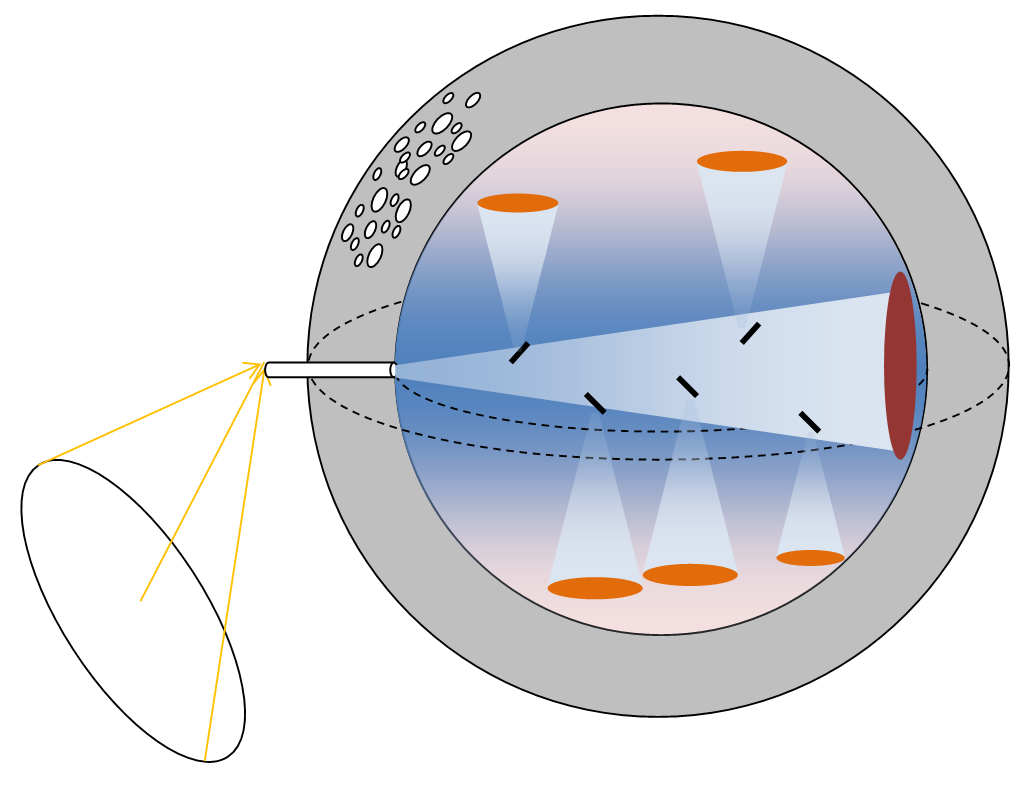
It's a wild idea to consider how this kind of effect would manifest itself in an extremely large space habitat with lots of atmosphere like a gravity balloon.  Getting light in, in the first place, would be difficult, but once you accomplish that, there's also the need to distribute it.  I imagine that this would be accomplished with something like a tree of mirrors.

The seperation of short and long wavelength light would apply to every section of light delivery.  The mass-thickness that we may be dealing with are actually much larger than what you see on Earth during the daytime, since that only loses something like 4% of the visible light.  What we would be looking at is something much more akin to the behavior of Earth's sky near sunset, where brilliant colors are scattered all throughout the atmosphere due to an extremely long path length.  These are only present when the bulk of the light is hitting the atmosphere at a very shallow angle on Earth.  In a gravity balloon, everywhere it went, it would have a large distance of atmosphere to travel through.  Because of that, I imagine (quite inexactly) separation of light in the following ways:


The basic dichotomy is the difference between light that makes it through and the light that gets scattered.  The scattered light is what you see represent the beam's path itself.  The combination of the two would still produce fairly white light on things that it shines on.  However, if the mirrors don't directly reflect the direct light from the sun to walls, then those walls should appear reddish or orangeish depending how far the light beams have traveled.

How this light would be practically used is a more difficult problem.  Artificial gravity tubes at self-blocking.  No one wants to get their lighting to come up through the floor.  I'm not even quite sure how that would work.  The friction buffers complicate the issue even further.  The edges can't be open to atmosphere because of the speeds they're traveling at and the power dissipation that would happen because of that.  That leaves only two fairly difficult options to get the light to the people:
  • A complicated system of mirrors to reflect light through the tube ends
  • Have transparent surfaces throughout parts of the ground and friction buffers

I don't have good answers for these issues.  Obviously one solution is to just not use sunlight in the first place and use entirely artificial lighting.  It is somewhat depressing that the best illuminated ares would probably be the zero gravity regions.  It's hard to see a way around that.  For either approach, going through the tube ends or the tube sides, some amount of additional light collection would be a necessity.  Also, if the tubes are spinning at 2 rotations per minute, that could be difficult to deal with psychologically.  Still, if you imagine that the windows are circumferential, and that light is reflected into it from all sides, then it could be maintained relatively constant, and the same argument applies for the ends.  Nonetheless, each of these proposals winds up demanding reflecting the sunlight at minimum three times.  One alternative would be to simply locate the artificial gravity tubes in the direct line of sunlight propagation to begin with.  That may be more reasonable than it sounds if there are multiple access tunnels that have sunlight concentrated on them from space.  In fact, this is probably the best approach - the eliminate the internal mirrors in the above illustration.  The approaches for distributing the sunlight around the rotating tubes themselves is something I have not done, although it could be neat, I'm a little short on clarity on the exact design issues that would be at play.