Tuesday, October 29, 2013

More Designs for Space Stations with Artifical Gravity

Notable space station designs for permanent habitation all share the basic principle, which is to rotate a single rigid structure at a speed necessary to produce acceleration similar to Earth gravity.  As an adjustment to these designs, I argue in favor of "multiple moving parts", because real-world complexities of operational demands and material economics, combined with the flexibility of zero gravity leave a significant niche for less-intuitive designs. 

This blog has proposed the use of "friction buffers" (as I call them) to reduce the fluid forces that drag on the cylinders rotating for artificial gravity.  Originally meant as a way to make the zero-gravity atmosphere of a gravity balloon useful, it has quantitative applicability for smaller designs, on the scale of the O'Neil Island One, Kalpana One, and others.  Both of these are proposed to have a diameter of approximately 500 meters.  This size comes from a necessity to minimize the false forces to make the place feel normal (to an Earthling).  Such a size and rotation rate would make it impractical to simply place the rotating ring inside a pressure boundary because of the energy needed to keep it spinning.  As I have argued before, there are ways around this.

Some proposals do, in fact, call for placing the rotating segment inside the pressure boundary.  In 2001: A Space Odyssey, the Discovery One ship had such a design.  This is evidenced by the way that the astronaut was able to climb up to the center of the ring, and then exit into the zero-gravity parts of the ship.  Adding a rotating segment onto some stationary space habitat creates an engineering dilemma, because it's completely impractical to maintain a pressure boundary at a rotating joint.  Your two possible solutions are:
  • envelop the rotating part inside of the pressurized part
  • keep the pressure boundaries of the stationary and rotating parts completely separate, and implement a go-between module which has an airlock that can engage both
The latter option is the exact solution that the Nautilus-X proposes, and has included in designs for the International Space Station.  In an obvious sense, this maintains modularity and doesn't disrupt other parts of the station, but it's important to think about the operational consequences.  The ISS is a large station that allows its occupants to float from one side to the other easily.  This would not be the same for the centrifuge module.  That module would be specially isolated.  To enter it, you will need to go into the cramped transfer chamber, close the airlock.  Wait.  Then experience the transfer chamber start rotating.  Then wait for the other airlock to engage.  Then you can crawl down into the module.

Anecdotal evidence has its limitations, so I want to take a solid technical approach to what these designs would mean for an extremely large station with a rotating ring diameter of 500 meters.  As I argued in the introduction post, the conventional artificial gravity cylinder needs a wall that can withstand the outward forces from air pressure, the load from humans and their stuff, and an additional load from the acceleration of the shielding material.  Because I was interested in specifically gravity balloons, I haven't gone into detail of the other options, so I will do that now.  To keep things simple, I will limit everything to the consideration of cylindrical artificial gravity tubes.  This confines it it to a 2D problem.

Different Cases of Interest
Labeled with Case Numbers 1 through 4


Case 1 represents the conventional notion of a space colony.  The benefits are simplicity.  The drawbacks (compared to other options) are greater structural material needs.  The entire matrix of advantages and drawbacks are tabulated below, and I will argue them in more detail.

Advantages and Disadvantages of Each Case

DesignAdvantagesDisadvantages
1. Conventional- Simple- Structural material requirements
- Structural material self-support
2. Decoupled Shielding- Roughly halves the cylinder structural load- Greater bulk material requirements
- Sunlight access
3. Decoupled Shielding
with Pressure Support
- Lowered leak rate
- Can use "sandy" shielding rock
- Extra airlock and pressure boundary
4. Decoupled Pressure Boundary- Access to zero gravity habitat
- Can use lower strength materials
- Stationary docking
- Can combine with self-gravitation effects
- Friction buffers needed
- Larger total air volume

Decoupled Shielding Envelope (case 2 and 3)

The most simple approach to reduce the material burden would be to simply decouple the shielding material from the rest of the station.  The shielding material would be stationary, and there would be relative motion between it and the pressurized habitat.  Shielding blocks radiation by eliminating all direct lines between the station and sources of radiation, so this would necessarily have to cover the station completely and block all light.  It would still be possible to have paths for incoming space craft to use to drive in, via labyrinth entrance paths.  It would even be possible to have a series of mirrors that reflect visible light while blocking radiation, as others have argued.

Mechanically, the shielding only has to support itself from its own self-gravity (which is case 2).  We can assess this using the large-limit approximation for a gravity balloon wall.  This would be assuming that the shielding would be a large sphere surrounding the rotating habitat.  Due to the nature of gravity, it turns out that it doesn't even depend on the size of the sphere.  Thus, by assuming a given mass-thickness of 10 tons per square meter (the same shielding provided by Earth's gravity) we have our final answer.
 

The way to interpret this number is that it's either the internal pressure needed to support the shielding sphere (which is case 3), or its the strength that the sphere has to have to keep from self-collapse (case 2).  It's an extremely low number, but it's compressive, which complicates things.  Also, the entire point of a decoupled shielding sphere is to use simple and abundant materials, so it's not trivial that this (extremely light) requirement will be satisfied with little effort.

Kalpana One does an innovative type of calculation when they consider the maximum length to diameter ratio reasonable for stability of a rotating space habitat, and they seem to come up with the number of 1.1.  Taking the diagonal, this gives a largest dimension of 743.3 meters, and the shielding sphere's diameter would have to be equal to this or larger.  It also includes a radiator skirt which is 200 meters beyond the extent of the habitat itself.  That adds up to 500 + 200 + 200 = 900 meters, which turns out to be the limiting dimension.  This is for a rotating cylinder of 500 meters diameter, so that gives us very nice intuitive guidance for the size that a shielding sphere would have to be, as well as the general numbers we might expect for the ratio of habitat floor space to the surface area of the sphere.

For a spherical pressure vessel with an outward or inward pressure (inward in this case, compressive), you can easily calculate the mass needed to maintain that pressure under the thin wall assumption.  Here, I do that, but do it in terms of volume instead.  This is to establish the thickness of a structural material needed to hold all the shielding in place.

Structural Sphere Thickness Needed to Hold
Shielding against its own Self-gravity

So, if the shielding materials were supported by bricks (which have a strength of 80 MPa), and the sphere had a radius of 450 meters, then we find that the needed thickness of the sphere of bricks would be 0.2 microns thick.  Obviously this would not be difficult to satisfy.  Any accounting of the cost of those materials to hold the sphere up in its intended form would basically be negligible.

However, it's still possible to eliminate the stresses in those members, which I think is necessary to address for theoretical purposes (which is case 3 specifically).  After all, you could fill the sphere with a gas of 0.014 Pascals, and that would be higher than the pressure in space in general.  There would be some interesting dynamics to this gas, but it would certainly not contribute significantly to the slowing down of the rotating cylinder.  You would not need to add any friction buffers or anything of the sort, and it could be basically scaled up infinitely (in the absence of other cosmic forces).  Even if you wanted to accept the concept of superlarge rotating habitats that some science fiction writers propose - being made of carbon nanotubes, this could still exist within the envelope of a spherical radiation shield, and have that tiny pressure which holds it up from self-collapse.

I did look around for designs that are of the general nature of using a rarefied gas to support a large construction, and I found one example on NASA spaceflight forum.  It includes the detail that we raise the material from a 400 meter asteroid into a larger sphere by inflating a balloon place in its center, and that it would be done by using a rarefied gas.  Then there is also mention of creating a sphere to rotate in order to get artificial gravity.  However, I'm not sure if the exact same type of configuration is what the poster had in mind, and the entire thing is peppered with other details that seem irrelevant or jumps in the logic that I simply do not understand.

It's possible that the pressure support of the shielding material might be more detrimental than helpful.  After all, what if you had a leak in the station?  That would quickly blow away all of the shielding material!  But then again, this might actually be useful.  If you could build a thin but flexible pressure envelope, then you could adjust the size of the shielding envelope at will by letting slightly more or less gas into it, creating a "blow-fish" space station.  Exactly why anyone would need to do this - I don't really know, but it's an interesting addition to the toolkit.  The configuration would be quite stable, since the expansion of the gas itself limits the size it can grow to without introducing more gas.  Condensing it would probably require some cryogenic type machinery, but it would be workable.

Decoupled Pressure Envelope (case 4)

In a cursory mathematical look at the structural mechanics, decoupling the shielding material from the rotation is a clear win.  Less so for the strength needed to contain the air pressure, but it deserves a closer look.  A constant theme here is that carrying extra material along with the rotation carries with it a significant penalty.  So far, I have neglected the fact that structural material in the cylinder must also support itself.  This argues in favor of decoupling materials from the rotation, but I'm avoid inclusion in this post because it gets complicated.  If the pressure-retaining structural materials are a large part of the shell's mass in an O'Neil cylinder, then that material should be counted as shielding material as well.  That gets complicated with piecewise functions so I'm leaving that out.

The concept for my reference case (call 4) is to simply make a large spherical pressure vessel in space, fill it with air, and also put a rotating structure inside of it.  The energy loss due to air drag per floor space was also previously calculated in this blog, given assumptions about the number of friction reducing buffers you surrounding the rotating cylinder with.  This causes some amount of bloat of the space the cylinder takes up, but it is conveniently similar to the Kalpana One radiator size, so I will opt to use its numbers for the ratio of total volume number.  All the airlocks will be located on the non-rotating pressure boundary, and access to the rotating cylinder is entirely open.

It is a bit unfair to compare this design to that of a fully rotating space habitat, because this is two stations in one.  One with Earth gravity, and a microgravity volume.  Between the two there is some wasted space that is a requirement of the physics of the friction buffers.  The relative velocity between the two reference frames is about 110 mph, so it is no laughing matter.  You still need an elevator to get between the surface of the artificial gravity tube and its center, but once in the center, you can float out into the rest of the station.  You are not at risk of being smacked by a 110 mph wall, because the friction buffers exist to break up the relative velocity in multiple stages.

Recall in a previous post I looked at price for floor space given assumptions about what materials cost.  The source I used there argued in favor of materials pricing that was proportional to strength and mass.  Lumping all material densities together, this argues that a certain amount of tensile strength is roughly identical regardless of the strength potency.  If true, decoupling the pressure envelope offers no identifiable benefit in terms of structural materials (unless you count its self-support).

However, I think there's speculative reason to maintain that this will not be the case.  The entire principle behind space manufacturing will be that the materials we have access to will be limited.  At least early on, we will seek to use what we have, and the more variety of material we can use, the less material we have to bring into our processing facilities.  This is where the idea shines.  It can reduce the high-strength material needs by an order of magnitude, which may be a great boon to the viability of space colonies.  The pressure boundary can be made of material of any strength, as long as the structural engineering is sound.  Adding more material never hurts (aside from making the airlock more difficult).  In other words, this allows us to use a very thick pressure boundary.

Assume some cost for high strength material in space.  Then assume some cost of low-strength material.  If the high-strength material is a cost driver, then the case for this scheme is made.  Of course, there are other multipliers at work, particularly the usable volume.

Mass Requirements for 
Spherical and Cylindrical Pressure vessels

Structural Mass Ratios for the two Cases


This is an example ratio of the increased material burden of this case.  Thus we conclude that if low-strength material is exactly 1.82 times cheaper than high strength material this will be cheaper in terms of the structural material.  However, there are other cost increases for case 4.  We have the energy costs to keep the cylinder spinning, which isn't necessary in the pure vacuum of space for case 1.  There is also the fact that case 4 uses more air in general, and procurement of air isn't free in the first place.  The premium for high-strength material would have to be sufficiently high to justify all these costs.

The dimensions for Kalpana One are certainly arbitrary, so I want to quickly cover a "capsule" case in general.  This is where a cylinder is capped on both ends by a half-sphere of the same radius.  This establishes the long dimension for the sphere, which is used to evaluate the ratio of structure material for both cases in the same way as above.


Structural Material Requirements of
Case 4 versus Case 1


Illustration of a Capsule Rotating Shape and
Relative Performance of the Cases

Here, we conclude that decoupling the pressure envelope will never reduce the total amount of material strength needed for a space habitat.  The best case is where the structural materials are in a 1-to-1 ratio for both cases, and this is actually unrealistic.  This is the scenario where the rotating structure is a sphere, and it's contained with another non-rotating sphere that holds the pressure in.  This doesn't afford space for the friction buffers so it couldn't actually be constructed.  Obviously you could take another route and envelope a cylindrical habitat in a cylindrical pressure vessel, but it seems this design route would be pointless as it would offer very little benefit.

The principle isn't entire new (refer to the 2001 reference), although I'm still looking for another reference that mentions anything like the friction buffers on this blog.  The idea of space colonization with similar methods has been thrown out there before.  For instance, someone on NASA spaceflight forum proposed a Demos station made of an inflated habitat with one atmosphere and a rotating ring inside of it to produce one Earth gravity.  The moon itself has so low gravity that the mechanical issues shouldn't really be a concern.  Aside from the friction buffers, everything else about the idea is in line with the case 4 I discussed.

Saturday, October 26, 2013

Expansive Zero Gravity Atmosphere Concepts Gaining Social Momentum


The Virga comic series has recently hit the (virtual) shelves, and it offers quite a vision of a world that continues seemingly infinitely in all directions, and yet is filled with air that a human can breathe.  This is an installation onto the Virga series by Karl Schroeder, a Canadian science fiction author.  At the time of writing this, Virga comics 1 through 3 are out, and I'm rather excited to see these vivid illustrations of such a world.  Naturally, I want to make a post that covers where it fits into my own views on such worlds.

I will continue to pick at the parts that I find to be particularly bad abuses of physics, but I should note that I find the comic and series extremely cool overall.  The comic, in fact, touched on a few elements of a mixed gravity (my own term) world.  This is a very new kind of environment that is being described, and the author has done a great service by working to popularize it.

Birds and Fishes

The Virga comic portrays fishes with wings.  Even Gerard O'Neill, in his book The High Frontier talked a good deal about fish, which I did discuss on Space Exploration Stack Exchange.  Other people were apparently interested in zero gravity dolphins, which I have to admit, was a little shocking.


(image copyright Virga Comics, used as fair use here
this is from Comic 3 which can be purchased from Comixology for $1.99)


And I feel like the odd one out, thinking that birds would be considerably more interesting.  Of course, my visions hinge around the "friction buffers".  In my own vision of the gravity balloon, a flying fish that gets caught up in the rotation of a cylinder will not fare well at all.  I have no idea how birds will manage to cope with zero gravity.  Still, I'm satisfied thinking "life will find a way", and imagine that birds will at least figure out how to propel themselves long enough to get to some food.  If they flew into an artificial gravity cylinder, then they would revert to their familiar flying mechanics.  I imagine birds would be quite sensitive to Coriolis forces as well, and learn to use them - getting extra "lift" by flying in the direction opposite of the rotation.  Birds are quite good at minimizing effort on Earth.  I doubt that zero gravity worlds would be comfortable to them, but they're also some of the most adaptable species on Earth.  But that's just my 2 cents.

In addition to the bird-fish in Virga, there are also some illustrations of humans with wings or just plain flippers on their feet.  That's very entertaining to see.  It really brings to life the world that we once thought would be the promise of air travel in the early 20th century.

The author also seems to have done a great deal to realize a vision he talked about in an article written about Virga when the idea was much younger.
"For years I’ve had flashes in my mind’s eye of an endless sky, and of towers and buildings floating in that sky. A particularly persistent image was of a woman standing at a tower window looking out over an ocean of cloud, with no ground beneath the tower."
This vision was basically realized.  I believe this is the exact vision the author had in mind when the comic's sort of castle-scape was drawn.


(image copyright Virga Comics, used as fair use here
this is from Comic 1 which can be purchased from Comixology for $0.99)


Novel Environment Physics

Several phenomenon are referenced in the Virga in-world that are quite unique to a mixed gravity world.  Things that stood out in particular:
  • spin downs, where the ring looses gravity
  • dropping out the bottom of the ring on a air-bike

While I haven't read much of the book series, they very quickly got the plot twist of a spin down in the first book.  This is an event where they stop spinning the ring, and everyone on it loses gravity.  This was reference in the comic, although not specifically illustrated to my knowledge.  This sort of thing is only really thinkable in a mixed gravity world, and so is the dispatch of the air bikes (there may be an official term for these, but I do not know it).  The idea there, is that people launch themselves out the bottom of the ring structure to provide quick access to the larger world.  That makes sense certainly, but it would definitely be a rush as you fall, fall, fall, and then wind up without any ground left to catch you.


(image copyright Virga Comics, used as fair use here
this is from Comic 1 which can be purchased from Comixology for $0.99)


I would have liked to see some mention of false forces in artificial gravity rings, but there's still plenty of material in the series I haven't got to.  I think the "preferred" direction in artificial gravity will be a very huge concept for people who ever live in such a place.  I think it will be almost incomprehensible to them that on Earth people can't distinguish easily between north and south.  But then again, in the free floating space between habitats, none of the 3 dimensions we live in can be distinguished.

There are some other details that are generic to large zero gravity environments too.  For instance, the way people move around sticks out.  The way people structure the beds sticks out.  Also, the ports are often in apparently zero gravity environments.  I think it would be difficult to manage in such an area, but I guess that's the idea, and that the people who live there are quite used to the concept.

These zero gravity artificts strikes me as similar to a particular vision of the future (actually the year 2000) by french artists Jean-Marc Côté and other artists, made for the 1900 World Exhibition in Paris.  These visions show people prancing around the skies in only minimalist wingsuits.   It's well past the year 2000 now, and all we have are wingsuit gliders which can't sustain horizontal travel for more than a few seconds.

 (Public domain images, source)


I find the similarities between these and the Virga comic rather stunning actually.  Sure, the physics and technology itself is different.  But in both we see impossible-seeming air vehicles, and people propelling themselves around with simple flaps.


Intermediate Scale Environments

I was very happy to see a number of creative environments that exist often on the scale beyond a single artificial gravity ring.  In Schroeder's vision, the Virga world has many small suns (really fusion reactors) which define a nation, which then consists of many gravity habitats.  If I am to take the expanse of such an area to be defined by the path length of photons in the atmosphere, this is quite large.  Actually, the heat would be intolerable near the sun itself because it would entail huge intensities, which would heat the air, which would cause other problems.  But I'm not determined to ruin everything.

Aside from the "suns" there are lots of other structures depicted.  In particular, green things that look like they have bushes growing on them, which I can only assume are some type of growing platform.  In the Virga comic, they portray many artifical gravity rings hanging from these structures.  This is very cool, as it represents a sub-scale to the "suns" or "nation" scale.  Larger than the suns/nations, there's still the air circulation patern in the Virga world.  I completely agree that this is sci-fi gold, because there's so much potential expanse to this world.  The scales that are or could be at work in a science fiction world are:
  • The individual rotating ring / cylinder
  • A cluster of rings, possibly tied together
  • Suns/nation level which spans the distance light can travel
  • Circulation patters, which are the largest grouping in super-large habitats
  • The gravity balloon itself
  • Possibly multiple gravity balloons within a solar system
The author did mention the possibility of the final scale somewhere in his online writings, but it's not central to the Virga story at all.
"Circulation is necessary because otherwise you run the risk of having the atmosphere condense and then freeze onto the outer skin of the sphere.  (This will only occur if it's orbiting in the outer part of a star system, of course--but in my books Virga does just that.)"
So in essence, this just fills in one scale of the hierarchy of the organization of such a place.


(image copyright Virga Comics, used as fair use here
this is from Comic 1 which can be purchased from Comixology for $0.99)


The Remaining Problems

Displayed front-and-center on the cover of the first Virga comic, probably the most iconic image of the series, is a man riding an air bike counter-rotation around the surface of an artificial gravity ring.

There's only one problem with this - it would never work that way.  I know, the idea is that the rotating structure "drags" the air with it, or something like that.  The only problem is, we already have models for this type of fluid mechanics problem, and it does exactly not do that.  I've written several posts on the fluid mechanics of the issue, and I've not seen a single thing that refutes the basic estimates of power dissipation per unit area, or the consequences of that.  In fact, the worlds portrayed in Virga are not "smooth" in the thermal-hydraulic sense at all.  They consist of macroscopic imperfections, otherwise known as buildings.  These would only add to the massive stirring of the atmosphere in that environment.  Not only would such a craft be unmanageable in the situation portrayed, but so would walking.

I don't know what kind of scale these illustrations are tying themselves to.  It seems pretty indefensible to imagine that they're much less than 500 meters in diameter.  The calculation is then simple.  Acceleration is v^2/r, and that equals to one Earth gravity.  Relative to the ambient air, that results in 110 mph.  Even if we were as generous as possible to the concept, we must somehow imagine that the airflow transitions from one stream which is at rest to another stream at this velocity.


Could the Idea Catch On?

Virga represents one extreme.  As I covered in my last post, there is a fairly specific limit to how large of a habitable area you could create with this type of method, and this science fiction world isn't far from that.  The scales and the simple expanse of the world are beyond our ability to think clearly about.  There's a meaningful place for this type of thought.  Particularly since this is a fully 3D world, the transportation limitations aren't actually any greater than Earth itself, in spite of being so many orders of magnitude more expansive.

On the other extreme, there's another reason to promote the concept of expansive zero gravity space habitats.  That's because they have good near-term prospects for space development.  The sales pitch is that we can pick a nice asteroid, walk in, and then just "put up the wall paper".  In practice, it's a little bit more complicated of course, but that description is quite an honest summation.  Asteroids of the relevant size might have enough fissures to allow us to venture straight into their center, unimpeded.  Then, even if we exert a pressure on the walls we're assured stability due to the fact that gravity itself would be sufficient to hold against the pressure.  Sure, there's a great deal of exploration and then analysis which would be requisite before we ever think about doing this, but it's something that can have safety demonstrated before hand, and it's something that can scale up to significant sizes for a significant number of people, all the while being in the depths of space.

The key to all of this, both the large and the small, is the prospect of a habitable environment which is sometimes zero gravity and sometimes artificial gravity - mixed gravity.  The smallest habitat within an asteroid with the "wallpaper" model may only host a small tube of low gravity and frustrating Coriolis forces.  But you can hop off of that to do work in zero gravity.

I come at this from the perspective of space advocacy.  The sci-fi world of Virga is the fantasy part of the spectrum, but the basic concept of a mixed gravity world are the same.  It's also really really cool.

Friday, October 25, 2013

Inclusion of Air Pressure Effects for Super Large Gravity Balloons

Although impractically huge, the math of a gravity balloon changes a great deal when they get beyond a certain size, in large part due to the pressure of the air itself.  There are quite a few related discussions that stem from this.  On Earth, for instance, we need our large gravity well to hold in air, but it's not so much because the upper atmosphere extends to escape-able distances at thermal velocities - far from it.  In terms of sheer value of density, our atmosphere is basically gone when you reach 40 km.

That altitude represents a Delta V value (the speed you would accelerate to if you fell that height in a vacuum) of 0.6 km/s, whereas the escape velocity for Earth itself is around 11 km/s.  The role our gravity-well plays is, instead, to fight against the "boiling" off our our upper atmosphere by higher energy particles from the sun and the cosmos.

To put this in different terms, if you wanted to blanket the Earth in a sheet to hold in its atmosphere, that sheet wouldn't need to be very thick.  A simple mathematical treatment of this is to say that the pressure drops off exponentially.  You need a constant to use in that equation, which is simple, and given by this reference to be 7 km.  You can very easily see that at 40 km, you're left with less than 1% of the air pressure, according to [P = P0 exp(- h/h0 )].

One might correctly notice that this has implications for a gravity balloon.  This raises the possibility of a super large type of gravity balloon, which perhaps looks more like a gas giant planet than a space station.  Formalize the problem by requiring a habitable pressure in the center.  Then that pressure decreases as you move away from the center.  There are a few possible non-ideal consequences of this, which are quite interesting from a physics standpoint.  Most obvious, the outer regions might not be entirely habitable due to a low barometric pressure.  This would only happen for extremely large sizes, and represents the ultimate upper limit.  Second, you forfeit the zero-gravity environment for a large part of the volume.  While the outer regions aren't zero gravity, they can still be very low gravity.  Going from 1 atmosphere of pressure to near-zero pressure requires a certain potential difference, but unlike Earth, that difference may be spread over a large difference for a super large gravity balloon, resulting is a very low field at any point.  It's possible that any residual gravitational field could be counteracted by wind turbines which have relatively low energy requirements.

The world I am describing comes awfully close to the conception of the Virga world.  Coincidentally, they just came out with a new comic series set in the Virga world, which I hope to write more about later.  In addition to the changing pressures, this world has convection currents (which might be physically accurate).  The author also goes on to write in a great deal of politics and dynamics to this world, which is tangential to this blog.

I have noted (as have others) that the Virga world doesn't need to have a wall of carbon nanotubes, but I haven't given very detailed consideration to how thick the walls might need to be, or even if these walls would be stable.  Wall thickness is, after all, a function of the pressure near those walls.  The technical guidance we have for Virga is that it is 5,000 miles in diameter.  I don't think we are given a pressure at any point inside this, but I will happily assume 1 Earth atmosphere in the center.

The Mathematical System

Governing equations are straightforward, but I found them deceptively subtle to get correct.  There are number of components, so I'll outline them in a list.  The goal here is to obtain a set of 2 differential equations that describe the atmosphere pressure and gravitational field within this structure as a function of the radius.  In order to get there, we have to formalize several physics equations.

Technical steps:
  1. I used the ideal gas assumption and constant temperature.  This relates pressure and density in a linear relationship.  Use the specific gas constant to write this explicitly.
  2. Mass is taken to be a function of radius, and includes all air mass below that radius.  This is then related to the field, making use of the shell theorem.
  3. Change in mass for a differential increase in radius is the sphere surface at that radius times the air density at that radius.  This is a geometrical statement.  Additionally, density is replaced with pressure from the ideal gas equation.
  4. Initial conditions are obvious.  The gravitational field is zero at the center, and this formalization specifies the pressure at the center to be the habitable goal.
  5. The differential equation for mass is then changed to be in terms of gravitational field, which comes from making a substitution from the shell theorem.  Some algebra is done, using the chain rule of calculus, and then rearranged.
  6. Pressure falls according to the density of air and the gravitational field, in the same way that Earth's atmosphere does, which I outlined in the introduction here.  This is written in a form usable as a differential equation.
For such a large volume, transport of heat out from the center to the outer regions becomes non-trivial.  This makes the assumption of constant temperature a little dubious.  We would probably expect some falling temperature with radius.  This is still pure presumption as to how this thing would actually be built, so I'll keep T constant for now.  The equations are complicated enough as they are.

This math is a little bit intimidating, and it turns out, the system can't be directly solved easily.  In the following equations, look at the last 3 lines.  Those fully specify the differential equation system.  With the constants filled in, you can put this directly into a mathematical software package.  Unfortunately, I have not yet found such a package that will give an algebraic answer, so I will have to satisfy myself noting that it can't be done without extremely exotic functions.

Governing Equations of the system
Last three constitute complete differential equations


The constants need definition.  Since this is a technical blog, I will list all of the physical constants employed here.  The gas constant is for air at sea level.  Generally, the values are sought to provide a normal Earth room temperature atmosphere, consistent with most of this blog and the idea of Virga.  It's possible to make an extension of this math to do primitive analysis of gas giants or stars.  Hopefully I can do that as another post some other time.
  • R_{specific} = 287.058  J / (kg K)
  • T = 293 K
  • G is Newton's gravitational constant = 6.67384e-11 m3/(kg s)
With this, the system is fully specified mathematically.  You have the ability to input the above equations, with the above constants, into a numerical integrator and obtain a spatial picture of the pressure and field within one of these bodies.  I have made my own code to do these calculations available on Pastebin here.

When talking about a gravity balloon, we are terminating the gas by adding a wall (in literal terms).  By the shell theorem, we should be comfortable ignoring everything beyond whatever radius we're looking at, because the gravitational field contributions all cancel out.  That is why these mathematics are relevant for large gravity balloons.

I was also interested in the effect that setting different pressures would have.  I tested two cases, where the central pressure was 1 atm and 3 atm.  A surprising result came out of this - that the pressure at large radii was lower when starting at a higher central pressure.  Actually, this makes complete sense.  This is why gases consolidate into gas giants instead of always hanging out in a large volume at low density.  This is telling the story of gravitational collapse of gases.

Pressure versus Radius graph


This has interesting consequences for gravity balloons.  You would think that containing more gas in the same space would require more container material... but that's just not the case here.  This is the strange nature of self-gravitation.  The air holds itself in (to a limited extent).  Now, there's also the valid question of whether 3 atmospheres of pressure is actually usable, and it's likely not because of Oxygen toxicity.  Because of that, it's not at all clear how the usable volumes between both of these compare.  But for sake of argument, let's take the pressure range for the "habitable" volume to be 0.8 atmospheres to 1.0.  With that specifier, I can compare the habitable volume between these two cases.  We're imagining that the center area of the 3 atm case will be treated as uninhabitable, but people could live beyond that radius.  Honestly, I think this looks closer to the sketches of Virga.

Table of Radii that certain Pressures occur at
and corresponding volumes with given range
Radiifor thePressure
(given in km)
1 atm3 atm
0.8 atm018,384
1 atm10,98718,590
Habitablevolume
caseV (km3)
1 atm5.5562E+12
3 atm8.83007E+11


Here we see that the habitable pressure would not be increased by adding more air to the system.  That's not entirely surprising, for the same reason that Jupiter doesn't have much volume at "habitable" (again, just 0.8 to 1 atm) pressures.

Properties of the Structure

There are two mass values of interest - the mass of the wall required to hold the air in, and the mass of the air itself.  For the wall requirements, the formula I have used so far for the "large case" needs to be revised.  Going back to my original question on physics stack exchange about this question, the large case has fit the equation of [ P = 2 G pi mu2 ].  That equation takes into account the self-gravitation from the wall itself, but not the gravity from the air.  So I've wrote another equation that does take it into account.  To solve this equation, it needs to be solved for the mass-thickness of the wall, and then simply multiply by the sphere surface area at that radius and that's the wall mass.


The calculation of air mass is trivial because it follows the same equation used in setting up the differential equations to begin with.  That equation is just recycled.  Now, here are the equations.  These are in terms of P(r) and g(r), which are the pressure and gravitational field throughout the air.  These are outputs of the code that I have on pastebin.

Expressions for mass of the air and wall of super large gravity balloon
(require numerical solution of previous set of equations)


We can now look at how the two independent variables (center pressure and the radius) affect the mass needed to construct the wall of this gravity balloon and fill it with air.  With my code output and these equations, I produced the following graph to illustrate this, and it gives a good picture of the general mass scales involved for different cases.

Graph of calculated masses of wall and air
given different radii of structure

Keep in mind that this graph is still using linear scales.  In terms of general observations:
  • The material requirements for the wall never reaches an absolute maximum.  This was one of the primary questions that was motivating me.  The wall mass requirements grow at a rate below even the surface area of the volume, but it continues to grow.
  • At super large radii, the gravitational field from the air itself dominates, which isn't very surprising.
  • The cross-over point is around 20,000 km (40,000 km diameter), which has an atmospheric pressure of 0.5 to 0.7 atm.  In other words, the air gravity starts to dominate while the outer regions still remain disputably habitable.

There's now a need for better reference values.  Earth's moon has a mass of 7.3 x 10²² kg.  This is a facinating reference point, because it establishes the the maximum practical size of a gravity balloon is right around the mass of the moon.  In terms of length scales, I just want to quickly note some other bodies for comparision.

radii for comparison
  • The Moon 1,738 km
  • Virga 4,023 km
  • Earth 6,378 km
  • Saturn 60,268 km
  • Jupiter 71,492 km

Compared to what's possible, Virga is somewhat small.  My expectation was that the pressure would varry significantly between different regions in it, but that expectation has proved wrong.  Virga's outer regions would only be about 4% lower pressure compared to its center.  However, I also need to volunteer the fact that if Virga was made as a gravity balloon, the walls would have more mass than all the air (and all other stuff) on the inside.

I also wanted to write a little more on the stability of such a massive construction, but I find myself at a loss on the subject.  This analysis included effects from changing pressure over the volume and gravitational effects from the air.  These will affect the stability of the walls, but I'm not entirely sure how or to what extent.  The gravity of the air is at least partially destabilizing, just how tidal forces are.  Come a little closer to center, and the gravity increases, and vice-versa.  This is characteristically unstable, but it probably isn't a game changer.  There's also the fact that the pressure increases as you go in further, and as far as I can tell, this effect will be more significant (in any case) than the tidal forces from the air.  All of this is concerning the particular deformation of one part of the wall falling in a little bit.  It seems that the dominating factor for that contingency is what it's always been - the change in the self-gravitation of the wall.  My expectation was that the wall-self gravitation would become irrelevant on large scales because the mass-thickness of the wall declines.  That happens, but probably not to the point of irrelevancy.  Even if you go so big that wall self-gravitation didn't dominate the stability discussion, the air pressure would be the dominant mechanism for these global deformations.  Of course, there's still the matter of "local" instabilities - which consist of leaks and wall Rayleigh-Taylor instabilities.

As for other observations, I want to quickly hit the escape velocity and the wall thickness.  At around 100,000 km radius, I find the wall thickness to be around 240 meters, if I assume a density of 3.5 grams per cubic centimeter.  Crowlspace was looking at about the same thing and came up with 1,345 meters at a 200,000 radius.  Of course, with larger radius the wall thickness will decrease.  This shows that Crowlspace's number is truly quite different from mine.  I believe this is because of the nature of the calculation he was trying to do, which wasn't considering any hetrogenous spatial distribution of the gas.

For the 1 atm central pressure case, I find an absolute maximum escape velocity (from the surface, including air and wall) to be 761 m/s.  This is a facinating result, because as long as you don't change the parameters like the central pressure or density, it is the maximum escape velocity that a gravity balloon can ever have.  It's also baffling because in Newtonian gravity, the gravitational potential of an infinite sheet of matter is infinite, and in large cases of this the wall starts to look a lot like an infinite sheet.  But that doesn't happen because the wall's thickness decreases with increasing radius.  Even more surprising is the magnitude of this number.  It's just not very fast, and even a bullet from a conventional gun can meet it.

Of course, the real question is where you would get all of that air from.  Wall materials for a gravity balloon can be anything, so the moon itself would literally suffice for this large limit gravity balloon's wall.  Earth's atmosphere is made out of fairly common elements, so that's not a constraint, but they would have to be processed in some sense.  I agree with the sense that such a large habitat would be in the outer edges of a solar system, but possibly they would be a complete interstellar space.  If near some clouds of gas of plentary nebula, perhaps the gases would be easier to collect.  I don't doubt that some dumb rock for the wall materials would be hard to find either.  But there's still the matter of turning whatever gas you have into molecular Nitrogen and Oxygen.  It's certainly a reasonable idea for speculation.  The scale is just so impossible for a humble human to consider.  A habitable area could literally exist accross a region 2 times the diameter of Earth.  The math tells us that is easily possible in terms of pressure alone.  But what would anyone do with all that space?

Friday, September 20, 2013

Asteroid Macroporosity and Caves

In their natural state, asteroids are not entirely solid, but reading up on the issue I've been surprised by the degree and distribution of empty spaces inside.  I posted about this on Space Stack Exchange, and obtained some really fascinating information.

For background, micro-porosity describes small voids of the type that we can measure from fallen meteoroids.  Those are to be expected (probably from some bubbling of intermixed volatiles).  Macro-porosity includes voids of large sizes.  How large?  It seems that no one knows.  In the fact of the massive deficit of knowledge, there are huge implications for our future in space.  The most shocking detail I encountered from that above question is this:

"The (scarce) theoretical works on that point predict an internal structure where most of the void are deep inside, while the shell around is pretty-much packed."

This is a fairly direct response to my own question - of how Mathilde can possibly look solid when literally half of it is empty.  No matter how long I stare at the pictures taken by the NEAR Shoemaker, I can't convince myself that there are any particular caves or anything of the like on this scale.


50% is no small fraction obviously.  A 1999 paper in Nature is a good example of what is probably meant by the scarce theoretical work in this subject.  These conglomerations would leave a large fraction of the interior as void, but it's hard to imagine it reaching half.

The mind boggles to transition from this relatively smooth surface to an interior made mostly of space, crisscrossed by boulders the size of American cities.  Would there be openings in the surface to these voids?  It starts sounding like the common sci-fi trope of a hollow planet.

Mathematics of Breaking Length

I keep returning to the importance of a number of mathematical details of structural mechanics of self-gravitating bodies.  The fearsome size (about 50 km diameter) of Mathilde is more incredible when you consider that the rock in the center is under constant stress from all that weight and is actually no worse off because of it.  The best model might be something like a gumball machine.  Each gumball is hollow and has to resist the pressures by 3 or 4 other gumballs pressed against its side.  This is the true failure mechanism.  It relies on the overall pressure of the pile, as well as its own size.

In general, the pressure that has to be resisted is the same central pressure that I've been calculating in this blog over and over again.  After all, the voids are literally a vacuum.  Actually, we don't know this for sure, but it's the best assumption we have right now.  There's no good case for how gases are held in.  If there were, that would constitute a natural gravity balloon.  While I think it's a fairly stable construction, that's after careful consideration and engineering to implement barriers that block gas movement.

This equation for central pressure is:

$$P = \frac{2}{3} G \rho^2 \pi R^2$$


to convert this into structural requirements, we need to introduce the material strength, sigma.  In a simplistic sense this can just be equal to pressure.  I have a mental image of a bar spanning the entire diameter, made of the same material as the rest of the asteroid.  Physically, this is fairly nonsensical butit gets the job done for a simple approximation.

$$\frac{\sigma}{\rho} > \frac{2}{3} G \rho \pi R^2$$


For the specific case of Mathilde's size and density, this requirement is 126 m2 / s2.  Compare to a specific strength for concrete of over 4,000 m2 / s2.  If anything, this probably indicates that the conglomeration of material inside the asteroid is, in fact, not strong.  Alternatively, it shows that a series of breaking and rearrangement has already taken place.

Consider the alternative of a building on Earth.  It also has some average bulk density that results in a pressure at the bottom.  Atmospheric pressure is disregarded because it's irrelevant to material failure.

$$P = \rho g h$$

For direct comparison we would like to put this in terms of material specific strength.  We have to decouple the "load" and "supports" to be practical, but I'm not too interested in that right now.  For

$$\sigma = g h \rho \\
\sigma / \rho > g h$$


This is the concept of breaking length.  For concrete the "breaking length" is 440 meters.  That corresponds to a specific strength value of (9.8 m/s2) (0.44 km) = 4,312 m2/s2. In short, this is saying that you could stand up a concrete tower 440 meters high, but no higher without it buckling under its own weight.  Self-gravitation is very fundamentally different.  To illustrate this point, I want to compare the two cases of resisting void collapse in asteroids to breaking length on Earth.  This is simply a matter of requiring the specific strength to be the same in both cases.  In a sense, we use breaking length as a metric of specific strength itself.

$$g h = \frac{2}{3} G \rho \pi R^2 \\
R = \sqrt{ \frac{g h }{ \frac{2}{3} G \rho \pi } }$$


For reference, Mathilde has a diameter of 53 km.  So resisting collapse of the voids at this size would be roughly equal to the task of resisting breaking over a length of 12 meters of the surface of Earth.  Obviously this is because gravity is weak, and the Earth is big.  Still, it's an interesting observation that's really hard to wrap one's head around.

Implication

In this blog, and elsewhere, it's generally taken for granted that making it to the center of a large asteroid would be difficult task.  For many, yes, this is the case since the macro-porosity is effectively zero.  For the majority, however, it's either fairly major (>5%) or we just don't know yet.

It's incredible to think that drilling to the center of such an asteroid... might not require any drilling.  You might be able to just float on in a giant cave entrance.  Exactly how much will be accessible and how easily is an unanswered question.

Even candidates like Eros have a major macro-porosity value, somewhere in the neighborhood of 10%.  This is a small amount of the total, but in terms of access, it could make an unbelievable difference.  If future methods could give a good idea of the 3D distribution of matter in an asteroid, and then the composition as well, then development of their resources will be a very different matter.

There are also major changes to the pressure-volume relationships.  I've never even considered the idea of increasing the density of the rock, but this would be possible for highly porous candidates.  It would be obvious to use the existing voids to store resources or excavated rock.  Doing so doesn't quite reduce the pressure due to self-gravitation.  On the other hand, moving around large rocks while at the same time avoiding cave-ins and other material rearrangement would not be an easy task.  Still, it's something that can be analyzed and worked around.

Thursday, July 4, 2013

Space Colonies Inside Irregular Asteroids

Any asteroids within the size-range suitable for a early gravity balloon colony would likely be highly irregular.  That is to say:
  1. the body exhibits a non-spherical shape, like a blob
  2. its rock has some amount of compressive strength
This was established with my last post, where you can see that basically any body with a natural internal pressure of 0.3 to 10 Earth atmospheres is likely to be irregular.  Those are also the internal pressures you need to use it as a colony.  Now, I'm using the term internal pressure, but so far I'm only referring to the contribution of self-gravity to internal pressure.  It could be more or less according to how the asteroid formed and what kind of internal forces it experiences as a result.  In this post I want to talk about how you would manage the most obvious kinds of internal forces for an early gravity balloon colony.


Irregular Asteroid Stresses

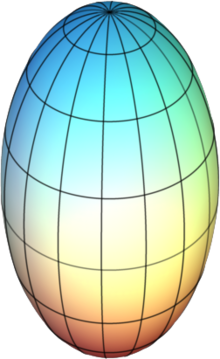
Call the largest dimension the polar axis.  This is chosen because it is the axis of symmetry.  In that case of planets, the axis of symmetry is typically the smallest one because they are roughly oblate spheroids, whereas 10-km scale irregular asteroids are more like a prolate spheroid.  In other words, this is the geometric model I'm using:

My terminology:
large dimension = polar axis


This doesn't look very far off for many of the asteroids we've photographed.  Eros, in particular, among others.  With this in mind, we can consider the stresses that he object's own self-gravity will cause on its interior.  For a mental model, this is somewhat similar to a building on Earth.  In order to "stick up", it has to have some strength.  The only difference between an asteroid sticking out as a prolate spheroid and a building standing up on the surface of Earth, is that the asteroid deviates from a spherical shape, while the building deviates from the flat surface of the ground.

This protrusion will only lead to compressive stress here.  After all, it doesn't have to stand up to the wind or any other dynamic forces.  If you want a rough formula for exactly how much compressive stress, then consider the gravitational head.  For a bad approximation, imagine that the gravitational field only varies with radius.  Then it's obvious that the equatorial radius is smaller than the polar radius.  That leads to an inconsistency if you imagine the object material is fluid-like.  You obtain a different pressure if you measure the elevation drop from the equator surface to the center versus if you measured from the polar surface to the center.  It is precisely the difference between these two pressure that is the non-isotropic force, or the compressive force.  It has the same units as pressure, because these are both elements within the stess tensor - the bread and butter of civil engineering.  After all, the entire proposal basically comes down to civil engineering.

For some math, you can imagine that this stress will be approximately equal to the gravity on the surface of the asteroid (which is an average figure itself) times the elevation difference at the equator and the pole.  Without going into details here, you can get a factor of 2/5 to add onto this.  This isn't perfect, but it's pretty good.

$$\sigma_z \approx \frac{2}{5} \rho g \left( R_x - R_z \right)$$

To illustrate the occurrence of this compressive force, I've used some arrows here.  Imagine that a pressure without any material stress would entail 4 arrows from all directions in this 2D approximation.  In reality pressure acts all around you.  So instead of that, we have some preferential direction where the pressure squeezes from only two sides.  I did my best to illustrate that for the prolate spheroid shape I'm talking about here.  This is briefly representative for the natural state of the asteroids I'm talking about.


You can easily extend the idea to a hole in the center.  About the same amount of net force will be present over a cross section at the equator.  If you drill a hole in the center, that means that there's less area over which to distribute this force.  Logically, that means that the stress would be intensified by the presence of this hole.

There are some finer points to this argument - mainly that in the above model the bubble would have to have some internal pressure.  This is what we're talking about for the gravity balloon.  Specifically, the pressure would have to be exactly enough such that the top and the bottom of the hole in the above image wouldn't experience any compressive stress.  You could change that with a different pressure inside the bubble.  If you increased the pressure in the bubble enough you would induce tensile stress - stress that tears the material apart, not pushes it together.  I have assumed that the pressure set-point would be carefully managed to keep all stresses compressive.

Why would you want to do this?  Because of the failure mechanisms associated with breaking.  If you compressive force doesn't hold up, then you could see some material rearrangement - just like if you had built your sandcastle too high.  That might still not result in loss of atmosphere.  Particularly if you had added some membrane to keep the atmosphere from diffusing into the rock to begin with.  There still remains a danger that whatever material rearrangement happens would destroy some part of that membrane, but it's still a smaller danger compared to failure of tensile stress holding the atmosphere in.  If you relied on the tensile stress of the asteroid, you would risk a catastrophic loss of atmosphere.  This is the same sort of event we concern ourselves with the international space station, or any similar design.  Breaks are generally fatal.

Impact of a Deformed Central Bubble

Similar thought experiments can be used for imagining that a small bubble is deformed in the shape of a prolate spheroid.  Start with the assumption that tensile forces are unacceptable.  Then imagine that we deviate from the spherical shape that I've always talked about for the inner bubble of air.  If you do this, that is effectively adding material around the equator region and subtracting it from the polar regions.

In doing this, we introduce a quadrupole moment.  This behaves as you would expect from a quadrupole field:

generic example of a quadrupole field


But in the case of a gravity balloon, we can only allow compressive stress, by adjusting the pressure of the air bubble lower.  Start out drawing the gravitational field lines from the quadrupole gravitational moment.  Then, due to the compressive stress argument, draw a compressive stress in all places where two arrows point toward each other.  This is what I've done in the image below.  You still have to use your imagination to think of this being an prolate spheroid.


There is an obvious utility to this - because the compressive stresses are in the opposite directions to the stress from the asteroid shape itself.  That means that an odd shaped bubble may be used to less the compressive forces within the interior of the asteroid.  That is exactly what you would do for management of interior forces, building a primitive gravity balloon colony.

In short, the combination of the two above stress diagrams gives a result that is overwhelmingly balanced back to isotropic forces.  That is, just pressure, no material stresses.  Like illustrated below.


gravitational balloon designed to relieve
stress within the asteroid rock

There's no reason to believe this could be done perfectly, but I haven't done the calculations.  I imagine it would be quite an involved project to do so.  Even as we imagine there will be some residual forces, it needs to be considered what the criteria is.  There seems to be every reason to believe that you could start with an asteroid like Eros and establish a colony with breathable air, several kilometers in diameter, all the while keeping the asteroid internal forces less than its natural state.

You would not want to stress the asteroid more than its natural state, because that will give you a virtual guarantee that loss of atmosphere will not happen.  That's the type of guarantee needed to have people seriously consider moving there, and that's why a gravity balloon is a competitive concept for space colonies.

Irregularity of Asteroids by Mass

The very fact that an asteroid is non-spherical proves conclusively that it has some material strength.  It would then be tempting to use its material to hold in an atmosphere, literally with no processing at all.  This would be cheap, but it would also be potentially dangerous as well as unnecessary.  The reason lies in a mass-scale argument.

Looking at what we know about asteroids, we can find that the size cutoff at which most bodies appear highly spherical is fairly close to the point where their internal pressure approaches 1 Earth atmosphere.  Because of this, it would be tempting to imagine that an asteroid's material strength may be nearly sufficient to maintain an atmosphere.  There are a few hazards with that argument, but the main takeaway is that it's not necessary.  Basically, self-gravitation is more useful than tensile strength because we have no reason to believe that an asteroid's natural tensile strength is reliable.  There are more complicated arguments involving the role of compressive strength, but I'll get into those with a later post.

Abundance of Irregular Asteroids by Pictures

Here are a few examples of asteroids at different scales that we have pictures of.  There is a combined imgage out there which preserves the length scale, although this isn't as useful as just looking at the images side-by-side, since I'm interested in their degree of irregularity.


PictureNameM (kg)Center Pressure
due to self-gravity
(in Earth atmospheres)
Type

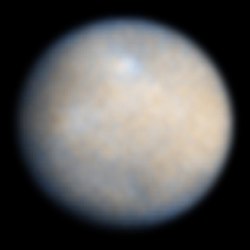
1 Ceres9.4 x 1020221spherical

4 Vesta2.6 x 1020185borderline


21 Lutetia1.7 x 10186.3irregular

253 Mathilde1 x 10170.27somewhat
spherical

243 Ida4.0 x 10160.36irregular

951 Gaspra2.0 x 10160.24irregular


433 Eros7.0 x 10150.12irregular


2867 Steins1.0 x 10140.0032irregular


4179 Toutatis5.0 x 10130.0027somewhat
spherical


25143 Itokawa3.0 x 10102.0 x 10-5irregular

There is somewhat a deficit of information beyond this.  If you want to see more pictures of asteroids (like I do), you might be out of luck, because almost every one of the pictures above represents a major space exploration mission.  There's also a pronounced deficit of information for Earth-like center pressures, since the above tables skips over an order of magnitude between Mathilde and Lutetia.

Note that pressure doesn't follow directly from mass.  This is because the objects have different densities, and I used those when calculating the center pressure.  A lower density will result in a lower central pressure, even for the same total mass.  That is simply a quirk of self-gravitation.

Once we get to the extremely small bodies, they seem to commonly take on the shape of an prolate spheroid.  Beyond one Earth atmosphere, the bodies all seem to conform to a roughly spherical envelope, even though there are a lot of irregularities on the surface.

For those small bodies, it's interesting to note that the speed of rotation also puts a limit on the amount of material stress we could expect from them.  A list of fastest rotating objects shows that some have a rotation on the order of a minute, but these are all several meters in diameter.

Largest Bodies Identified Irregular

Another reference for this is the Wikipedia list of solar system objects by size.  I went through that table and grabbed the largest objects that were identified as irregular.  This is a good approach because it gives a mass figure below which irregular objects start to appear is large number.  However, its major shortcoming is that we have no idea how many corresponding regular bodies exist around their mass scale.

ObjectM (kg)Shape
Proteus (moon)5.0 x 10¹⁹ irregular
Nereid (moon)3.1 x 10¹⁹ irregular
52 Europa1.7 x 1019 irregular
Davida4.4 x 1019 irregular
Sylvia1.5 x 1019 irregular
Cybele1.8 x 1019 irregular


Reasonable accounting would put the limit for irregularity at somewhere between 1017 and 1019 kg.  However, the limit I've found for a habitable inner pressure is around 1016, and can even be lower than that.  Engineering limits are still more complicated.  Even though bodies in this size range are irregular, they're still roughly spherical in many cases, indicating that material strength doesn't hold up on the scale of self-gravitational forces.  Within the size range we're interested in, the bodies are showing that they withstand some deformation against the equipotential criteria, but exactly how much is unclear.

This evidence does give a clear message - that using an asteroid to hold breathable air would involve both self-gravitation forces, as well as some material pushback.